About Us
The Miami Heat are a professional basketball team based in Miami, Florida, United States. The team is a member of the Southeast Division in the Eastern Conference of the National Basketball Association (NBA). They play their home games at American Airlines Arena in Downtown Miami. The team owner is Micky Arison, the general manager is Pat Riley and the head coach is Erik Spoelstra. The mascot of the team is Burnie, an anthropomorphic fireball.
The Heat were formed in 1988 as an
expansion franchise. Along with the
Orlando Magic,
the Heat are one of the two NBA franchises that represent the state of
Florida. Since entering the league, Miami has fielded squads that have
made the playoffs 16 out of 24 seasons, capturing nine division titles,
three Eastern Conference Championships, and two NBA Championships,
defeating the
Dallas Mavericks 4–2 in the
2006 NBA Finals and the
Oklahoma City Thunder 4–1 in the
2012 NBA Finals. Their playoff run in the 1990s was largely marked by
a vicious rivalry with the
New York Knicks. According to
Forbes Magazine, in 2010 the value of the franchise was about $425 million.
1987–1995: Early years
The Heat played their home games in the Miami Arena from 1988–1999
In Florida, a state devoid of NBA franchises, groups from Orlando, Tampa/St. Petersburg
and Miami all vied to land franchises. The Miami Sports and Exhibition
Authority eventually endorsed a group led by NBA Hall of Famer Billy Cunningham and former sports agent (and lifelong friend of Cunningham's) Lewis Schaffel, who received their financial backing from Carnival Cruise Lines founder Ted Arison,
who would be majority owner. Day-to-day operations would be handled by
minority shareholders Cunningham and Schaffel. In April 1987, the NBA
expansion committee endorsed the bids of the cities of Charlotte and Minneapolis.
However, the committee was split between awarding the third and final
franchise to Miami or Orlando, causing representatives from both cities
to toss barbs at the other. Finally, it was decided that the NBA would
expand by 4 teams, with the Charlotte Hornets and Miami Heat debuting for the 1988–89 season and the Minnesota Timberwolves and Orlando Magic beginning for the 1989–90 season.[2] At the survey for the choice of the name, Miami Heat defeated Miami Vice, the famous detective show set among the palms of South Beach.
The Heat came into the NBA for the 1988–89 season with an
unproductive first year, with a roster full of young players and
journeymen. Among the players on the inaugural roster were first round
picks Rony Seikaly and Kevin Edwards, fellow rookies Grant Long and Sylvester Gray as well as NBA vets Rory Sparrow, Jon Sundvold, Pat Cummings, Scott Hastings, Dwayne "Pearl" Washington and Billy Thompson. The team started out the season by losing its first 17 games, including a blowout 138–91, to Magic Johnson's Los Angeles Lakers, at the time an NBA record. It did not help that the Heat were placed in the Midwest Division of the Western Conference,
in defiance of all geographic reality. This forced them on the longest
road trips in the NBA; their nearest divisional opponent was the Houston Rockets,
over 900 miles from Miami. The team ultimately finished with a
league-worst 15–67 win-loss record (tied for worst season in franchise
history).
Original Heat logo used from 1988–1999
To help address Miami's league-low point production, the Heat picked Glen Rice from the University of Michigan in the first round of the 1989 NBA Draft, and Sherman Douglas of Syracuse University in the 2nd round. The team also moved to the Atlantic Division of the Eastern Conference
for the 1989–90 season, where they would remain for the next 15 years.
However, the Heat continued to struggle and never won more than two
consecutive games, en route to an 18–64 record. The 1989–90 season saw
Miami awarded with the 3rd pick overall, only to parlay via two trades
(first with the Denver Nuggets and later with the Houston Rockets) into getting the 9th and 12th picks, with which they selected Willie Burton of the University of Minnesota and Alec Kessler of the University of Georgia.
Both picks flopped, as the Heat tried to turn Burton, a college small
forward, into a shooting guard without much success and Kessler was
bogged by injury problems and was not physical enough to be a quality
NBA power forward. While Rice, Seikaly and Douglas all showed
improvement from the previous year, Miami still only went 24–58 and
remained in the Atlantic Division basement. Rothstein would resign as
head coach at the end of the season, but later would return to the Heat
prior to the 2004–05 season as an assistant coach, a role he still
fulfills today.
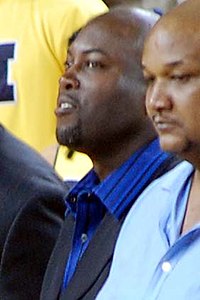
Glen Rice played six seasons with the Heat from 1989 to 1995.
In the wake of Rothstein's resignation prior to the 1991–92 season, the Heat hired Kevin Loughery, who had 29 years of experience in the NBA both as a coach and a player, to be their new head coach.
For the 1991 NBA Draft, the team selected Steve Smith from Michigan State, an agile guard, to usher in a new era of a mature Heat team. With the help of rookie Smith, Rony Seikaly,
and a more experienced Glen Rice, the Heat finished in fourth place in
the Atlantic Division with a 38–44 record even with a shocking defeat
against the Cleveland Cavaliers 148–80 and made the playoffs
for the first time in their history, becoming the first of the four
late 80's expansion teams to do so. Playing the league-best Chicago Bulls,
the Heat were swept in three games. Steve Smith made the NBA All-Rookie
team and Glen Rice finished 10th in the NBA in scoring.
The 1992-93 NBA season included the additions of draft choice Harold Miner of the University of Southern California as well as trading a 1st round pick (which would turn into the No. 10 overall pick the following season) for Detroit Pistons forward/center John Salley.
While Salley's addition was first met with hope because of the role
that he played on two championship Pistons squads, it became quickly
apparent that Salley was a quality role player for a good team, but not a
quality player for a mediocre team like Miami was at the time. Salley
would eventually have his playing time diminish, ultimately resulting in
his being taken by the Toronto Raptors in the 1995 expansion draft.
As for the season itself, it started off poorly, with Smith missing
time with a knee injury and Burton being lost for most of the year with a
wrist injury. Upon Smith's return, Miami posted a winning record in
February and March, but it was not enough to dig themselves out of the
13–27 hole they began in. They finished 36–46 and would not return to
the playoffs.
A healthier squad fared better in 1993–94, posting the franchise's
first-ever winning record at 42–40 and returning to the playoffs as the
No. 8 seed versus the Atlanta Hawks. After Miami had a 2–1 series lead,
Atlanta rallied from the deficit to win the best-of-5 series. After that
season, Steve Smith would be selected as a member of the 2nd Dream
Team, the collection of NBA All-Stars who were selected to compete in
the 1994 FIBA World Championship in Toronto as Team USA. Dream Team II,
also made up of future Heat players Shaquille O'Neal, Alonzo Mourning,
Dan Majerle and Tim Hardaway, would go on to win the tournament. In
1994–95, the team unexpectedly overhauled their roster, trading away
Seikaly, Smith and Grant Long in exchange for Kevin Willis and Billy
Owens. It was a widely unpopular decision, as the Miami community had
grown to love Grant, Long and Seikaly when they were with the Heat, and
the owners' sudden decision to trade them away left a bitter taste in
the mouths of the fans, especially since Willis and Owens were busts.
1995–2000: Rise to Prominence
Amid their losing record and lack of an identity, Lewis Schaffel and
Bill Cunningham began the process of selling their interest in the team,
throwing the Heat into a chasm of uncertainty. However, Micky Arison,
son of franchise patriarch Ted Arison, stepped forward to purchase the
Heat on February 13, solidifying control of the franchise to his family.
As the new Managing General Partner, Arison hired Dave Wohl as general manager, who fired head coach Kevin Loughery and replaced him with Alvin Gentry
on an interim basis to try to shake up the 17–30 Heat. Gentry went
15–21 for the remaining 36 games of the season for a 32–50 record
overall, 10 games off the previous year's mark. During that interim
period with Gentry, the Heat got their best win of franchise history
when they beat the Los Angeles Clippers 126–83. Furthermore, Rice scored 56 points against the Orlando Magic, setting the record for the highest individual single-game point total at the time. At the NBA All-Star Game in Phoenix, Arizona, Heat player Harold Miner repeated as the winner of the NBA Slam Dunk Contest and Glen Rice
won the NBA Three Point Shootout. As Arison began remodeling the Miami
Heat into a championship-contending organization, the continued
improvements of the Heat players garnered major media attention,
although the Heat would go on to miss the playoffs for the fifth time in
seven years. However, the fortunes of the Miami Heat would change
dramatically in the summer of 1995; the off-season of that year became
one of the most poignant in the history of the franchise.
1995–1996: Arrival of Pat Riley

Team president and general manager
Pat Riley coached the Heat to the NBA championship in 2006.
Setting the tone for a new era of Heat basketball, Arison hired Pat Riley to be the new head coach and team president of the Miami Heat; Riley resigned as coach of the New York Knicks
immediately following the 1994–1995 season. In a welcoming ceremony,
the city of Miami held a parade for Riley when he first arrived at
Miami. Shortly thereafter, Randy Pfund, Riley's former assistant on the Los Angeles Lakers,
was brought in to be the Executive Vice President of the Miami Heat.
Determined to bring a championship to Miami, Riley dropped a bombshell
two nights before the season began, sending Glen Rice, Matt Geiger
and four other players to the Hornets in exchange for All-Star center
Alonzo Mourning. At the beginning of the season, the Heat won eleven of
their first fourteen games. In mid-December, the Heat faced the Knicks
for the first time in New York; Riley received a very negative reception
from the fans, who often called him "Pat the Rat" for leaving the
Knicks, something Riley embraced.
By the end of February, with the Heat languishing at 24-29, Riley
continued overhauling the team. In a flurry of midseason deals, Riley
completed three separate deals involving ten players that would include
the acquisition of Tim Hardaway, Chris Gatling and Walt Williams. However, before those three could arrive in Miami, there was a game to be played against the 72–10 Chicago Bulls.
With only eight players available on the roster, the Heat hustled to
get their ninth teammate, in order to accommodate league rules; had Tony Smith not arrived in time for the team, Riley would have literally "signed someone off the street". Rex Chapman, who was traded to the Heat from the Washington Bullets, led the Heat to the biggest upset victory in Miami Heat history, defeating the Bulls 113-104.
Upon joining the team, Mourning and Hardaway quickly became the
centerpiece of the Miami Heat; Mourning's defensive presence and
rebounding expertise complimented Hardaway's play-making as a point
guard. Along with their individual scoring dominance, Mourning and
Hardaway formed one of the most dangerous tandems in the league at the
time, bringing a new excitement to the Miami community and turning the
Heat into perennial contenders. Finishing with a 42-40 record, the Heat
made the playoffs for the third time in franchise history, but were
swept in three games by the Bulls. However, the new-look Heat garnered
optimism for a bright future, and they would continue to improve the
following season.
1996–1997: Making the Conference Finals
In the summer of 1996, the Miami Heat continued revamping their roster, trading Tyrone Corbin, Terrence Rencher, Tony Smith, Gatling, Williams and Chapman. They were planning on bringing in Juwan Howard and PJ Brown
on July, but the league disallowed the Howard deal, preventing him from
playing with the Heat. On the other hand, they would retain Brown and
signed him to a contract. Although initially an enigma as a player, the
surprisingly athletic Brown was a jack-of-all-trades, who would hustle,
score, rebound and block shots whenever needed; Brown would become one
of the most important role players for the team. Voshon Lenard and Dan Majerle
were also added to the team, becoming a dangerous backcourt duo for
their tenacity on defense and their specialization at three-point
shooting. Majerle in particular added some versatility due to his
prowess as a passer. Adding one final piece for the team, Riley acquired
Jamal Mashburn,
an athletic, high-scoring swing-man that could take whatever role that
was asked of him. Throughout the 1996-1997 season, Riley drastically
transformed the new-look Miami Heat into a defensive-minded juggernaut
with an emphasis on unselfish work ethic, hustle and cooperation.
Quickly becoming championship contenders, the Heat clinched a winning
record of 32-9 on the road, earning the epithet of "Road Warriors".
The Heat were the biggest surprise and the league's most improved
team in the season; they won their first-ever Atlantic Division title
with a 61–21 record, the best regular season record in Heat history at
the time. Entering the playoffs, the Heat faced the Orlando Magic in the first round, blowing the Magic out in the first two games. As the series shifted to Orlando, Rony Seikaly, who was traded to Orlando, sprained his ankle in Game 3. Penny Hardaway and Darrell Armstrong
led the Magic to win Games 3 and 4, extending the series to the
decisive 5th game. In Game 5, Miami built a 17-point led, but Orlando
closed to within three points in the fourth quarter. During the final
seconds, Hardaway sank a three-point dagger that defeated the Magic,
winning the first playoff series for Miami Heat. On May 8, Riley was
named NBA Coach of the Year, becoming the first NBA coach to win that
award on three separate teams.
In the highly anticipated Conference Semifinals, the Heat would face
the Knicks, of whom they shared many of the same defensive attributes
and work ethic. The rough playing led to fierce competition throughout
the series, sparking the beginning of one of the most vicious rivalries
in NBA history. Patrick Ewing, with 24 points, led the Knicks to a game 1
victory. Two nights later, Tim Hardaway's
34 point performance helped the Heat even the series with a Game 2 win.
After losing Games 3 and 4 at New York, the Knicks took a commanding
3-1 series lead. On May 14, the series shifted back to Miami for Game 5;
it was a rather intense affair, with tempers flaring as the Heat's lead
grew in the fourth quarter. Towards the end of the game, P.J. Brown and Charlie Ward
got tangled up after a Heat player shot a free-throw. The usually
mild-mannered Brown body-slammed Ward over his shoulder, sparking a
brawl between the Knicks and the Heat. It resulted in suspensions for
Ward Ewing and Allan Houston for Game 6, as well as Larry Johnson and John Starks
for Game 7. Miami would play the rest of the series without Brown, who
watched the last two games from his hotel room. After winning Game 6 on
the road, the deciding Game 7 was on Miami. After Mourning committed his
fifth foul, he was forced to sit out on the rest of the game. In
response, Hardaway took over the game, finally closing out the Knicks.
Appearing in their first Eastern Conference Finals, the Heat faced the Chicago Bulls.
After falling behind 0-3, Mourning famously guaranteed a Game 4
victory. He lived up to his word, defeating the Bulls by eight points.
However, Mourning was suspended for Game 5 due to elbowing Scottie Pippen
in the head; the Bulls would defeat the Miami Heat in the playoffs for
the second consecutive year. Nevertheless, the Heat, coming off their
greatest season yet, were finally in the championship-contending
conversation.
1997–1999: Repeat New York Upsets
During the offseason, the team's focus shifted to building a new,
better arena to replace the Miami Arena. After overcoming political
opposition, the organization celebrated their 10-year anniversary as
AmericanAirlines Arena broke ground on January 27, 1998. The Heat had
another great regular season in 1997-98, ultimately finishing 55-27. Not
much had changed from a year earlier heading into the 1998 Playoffs.
Once again, the Heat were Atlantic Division Champions. Once again, they
were the #2 seed in the East, with the Chicago Bulls,
once again, holding the #1 seed. The New York Knicks were the #7 seed,
which meant that that the Heat would once again battle with their
fiercest rival from the year before. Only this time, it would be in the
first round; a best of five series. The two teams seemed evenly matched,
with Miami taking Games 1 and 3 and New York taking Games 2 and 4. The
most memorable moment of the series came at the conclusion of Game 4
when an altercation erupted between Alonzo Mourning and Larry Johnson. This is the fight in which Jeff Van Gundy
infamously grabbed onto Mourning's leg in an attempt to intervene. More
importantly, it resulted in Mourning being suspended for the deciding
game of the series. Many Heat fans felt that Johnson, knowing the Knicks
had already won Game 4, deliberately provoked Mourning with only a
second left on the clock so that he would be suspended for the
series-deciding game, in an attempt to not only give the Knicks extra
leverage, but to avenge the suspensions from the previous year.
Regardless of his intent, it worked, as the Heat were no match for the
Knicks in Game 5 without their all-star captain and defensive
centerpiece. New York took the series 3-2, pulling off a first round
upset. After Mourning was ejected from Game 4, Riley was seen outside
the visitors' room at Madison Square Garden, resting his hands on the
wall and hanging his head down, contemplating the loss of Mourning for
Game 5.
After a devastating upset loss to the Knicks in the 1998 Playoffs, the Heat immediately geared up for the 1998-99 season. with Michael Jordan, Scottie Pippen and Phil Jackson
all leaving Chicago, the Heat were considered major contenders to claim
the top spot in the east. However, just a few weeks into the offseason,
a massive lockout began, and it became unclear whether there would even
be a 1998-99 season. This was the first work stoppage in NBA history
that resulted in missed games. Several months passed and everything
remained up in the air. Finally, in January 1999, the National Basketball Association and the National Basketball Players Association
reached an agreement on a new collective bargaining agreement. All
teams played a shortened 50-game regular season schedule beginning on
February 9 with very limited days off.
Despite the grueling schedule, the Heat emphatically lived up to
expectations during the 50-game season, claiming the 1st seed in the
East just as they were favored to. Alonzo Mourning
in particular had a great season, leading the league in blocks and
winning Defensive Player of the Year. He was also named as the Center
for the All-NBA First Team (beating out Shaquille O'Neal) and was the
runner-up for NBA Most Valuable Player, with Karl Malone winning the award. Had Mourning won MVP over Malone, he would have joined Michael Jordan and Hakeem Olajuwon
as the only players to win MVP and Defensive Player of the Year in the
same season. Miami would have a conference-best 33–17 record to claim
their first-ever No. 1 seed in the NBA Playoffs.
In the first round, they were once again matched against their rivals,
the New York Knicks, who had struggled through the 50-game season and
barely slipped into the playoffs with the #8 seed.
During the first four games, the Knicks took Games 1 and 3, and the
Heat took Games 2 and 4, the exact opposite of the year before. For the
third year in a row, it came down to one final, deciding game at the
Miami Arena. The Heat led throughout the entire 4th Quarter and appeared
to be closing in on avenging the previous year's loss, but the Knicks
managed to cut the deficit to 1. With only a few seconds left in the
game, Terry Porter had Latrell Sprewell
trapped on the baseline and Miami was on the verge of narrowly
escaping. Porter took a stab at the ball, and it went out of bounds, but
the officials declared it was still New York's ball. After Porter had
Sprewell trapped with only a few seconds left, the Knicks now had
another chance to inbound the ball and attempt a game-winning shot. Charlie Ward inbounded to Allan Houston,
who immediately dribbled through a massive gap and put up a floater.
The ball bounced off the rim, onto the backboard, back onto the rim, and
fell in. The Knicks had pulled off one of the greatest upsets in NBA
history, becoming just the second #8 seed to knock off a #1 seed in the
playoffs. For the second year in a row, the Heat were stopped dead in
their tracks by the Knicks.
1999–2000: Final Loss to New York
After three failed attempts at a championship run and two consecutive
seasons of first round-heartbreak against the determined Knicks, the
Heat looked forward to the 1999-2000 season. In preparation for the new
season and new millennium, the franchise underwent, taking a new set of
uniforms which are still used today. The logo was updated, as well, and
on New Year's Day 2000, the Heat were to play their first game in the
brand new AmericanAirlines Arena.
Once again, the Heat showed tremendous promise in the regular season,
starting off 15-4 while still playing at Miami Arena. On January 2,
2000, the Miami Heat defeated the Orlando Magic in the first game ever played at AmericanAirlines Arena.
The Heat finished 52-30, earning their fourth straight division title
and the 3rd seed in the East. Mourning led the league in blocked shots
and repeated as Defensive Player of the Year. Mourning and Hardaway
brought the Heat to the playoffs for the fifth straight year, but
Hardaway suffered an injury that kept him from competing.
In the first round, they met the #7 seeded Detroit Pistons. Even without Tim Hardaway,
Miami won the series 3-0, the first sweep in franchise history. This
brought the Heat to the Conference Semifinals against the Knicks,
battling with New York for the fourth consecutive postseason. The series
began in Miami, with Hardaway returning to the starting lineup, but it
was Mourning's 26 points that took a Game 1 victory. The Knicks evened
the series with a six-point Game 2 win in Miami. Game 3 was at Madison Square Garden,
with the Heat winning in overtime. As the series continued, the Knicks
would win Game 4 and the Heat took Game 5, taking a 3-2 series lead.
However, the Knicks won Game 6, forcing a deciding 7th game in Miami.
The Heat had control of the game with a minute to go, but Mourning went
for a steal on Ewing, when he could have forced a tougher shot; it
allowed Ewing to dunk, bringing the Knicks ahead by one. Following a
timeout with seven seconds to play, Mourning gave the ball to Mashburn,
thinking that Mashburn would make the shot. However, Mashburn was
double-teamed by Ewing and Chilps, so he threw it to Clarence
Weatherspoon. After dribbling passed his defender, Weatherspoon pulled
up for a jump shot, but the ball bounced off the backboard; New York won
the game by one point.
2000–2003: Brief Decline
After being knocked out of the playoffs by the New York Knicks in the
series-deciding game for the third straight season, Pat Riley decided
it was time for the Heat to undergo some changes. After losing out to
the Orlando Magic to get Toronto Raptors swingman Tracy McGrady, Miami decided to trade Brown and Mashburn to the Charlotte Hornets (among others) in exchange for Eddie Jones, Anthony Mason and Ricky Davis. Miami also picked up Brian Grant to go along with the core of Mourning, Hardaway, Majerle, Bruce Bowen and Anthony Carter. That summer, Alonzo Mourning and Tim Hardaway traveled to Sydney, Australia
to be part of the second Olympic "dream team" that would eventually win
the gold medal, making them the first two Heat players to ever win
Olympic gold medals.
Unfortunately, the elation soon turned to fear. On the plane ride
home from the Olympics, Mourning noticed that his legs were very badly
swollen. Upon getting a physical the next day at the start of training
camp, it was discovered that Mourning had a chronic kidney disease:
Focal segmental glomerulosclerosis. On October 16, 2000, it was
announced that Alonzo would not play in the 2000-2001 season. The Heat
missed Mourning for 69 games in 2000–01, yet found success with Grant,
Jones and Mason, the latter of whom was named to his first All-Star
game. Led by Hardaway, the Heat embarked on yet another winning season,
with a 50-32 record, earning the 3rd seed in the Eastern Conference.
With 13 games remaining, Mourning surprisingly returned to the Heat's
lineup on March 27, 2001 against the Toronto Raptors. He would make the game-winning dunk several weeks later against the Milwaukee Bucks.
With their full lineup intact for the first time all year, the Heat
were qualifying for the playoffs for the sixth straight season. The Heat
met the 6th seeded Charlotte Hornets
in the first round, the same team they had traded Mashburn and Brown to
the previous summer. Despite having the better regular season record,
the Heat were absolutely obliterated by the Hornets. Charlotte took the
first two games in Miami by 26 each, before closing out the series on
their home floor by 15. Mourning in particular was a shell of his
former, MVP-candidate self. This loss marked the end of the
Mourning-Hardaway era that had started 5 years earlier. The Heat would
not make the playoffs again for several years.
The following two seasons were two of the worst in Heat history. Pat Riley
missed the playoffs for the first time in his coaching career, and much
of the remaining core from the division-title winning Heat teams of the
late 1990s departed (Tim Hardaway, Bruce Bowen and Dan Majerle). Miami rounded out its 2001–02 season roster with players well past their prime such as Rod Strickland, Chris Gatling, Jim Jackson, LaPhonso Ellis and Kendall Gill
along with Mourning, Jones, Grant and Carter, whom the Heat signed to a
controversial three-year deal that many said was far too much for the
young guard. And to acquire Gatling, Riley and the Heat traded away
Ricky Davis, a young, promising player. The trade drew a lot of
criticism at the time. The Heat also signed two young, undrafted players
in Malik Allen and Mike James to make up for not having a first-round pick in the draft. Miami also signed Vladimir Stepania to back up Mourning at center. The veteran team narrowly missed the playoffs, despite having a losing record at 36–46.
Miami began to rebuild in 2002–03. Thy drafted Caron Butler in the first round and Rasual Butler in the second round of the 2002 NBA Draft. Miami supposedly missed out on potentially selecting Yao Ming by one ping-pong ball during the draft lottery[citation needed].
Mourning missed the entire season due to his condition worsening and
Eddie Jones also missed a huge portion of the season with an ankle
injury. Miami signed Travis Best
to be the starting point guard. The Heat was led by Caron Butler and
many of the youthful players that have filled out the Heat's roster
since 2000 including Eddie House, Carter, Stepania, Allen and James. The
Heat finished 25–57 to end the 2002–2003 season as Riley stepped down
as head coach and the team finished 7th in the Atlantic Division.
2003–2006: Resurgence
2003–2004: Arrival of Dwyane Wade

Dwyane Wade was drafted fifth overall by the Heat in 2003. He won the Finals MVP award in 2006.
Alonzo Mourning's huge contract expired the following summer, giving
the Heat some much-needed cap room to rebuild. However, Miami was still a
few million dollars away from signing a max contract player. On July 1,
2003, Miami was expecting to hear from Bill Duffy, agent for Anthony
Carter, who was expected to make $4.1 million the upcoming season
provided he exercised his option. Duffy's agency never informed the team
and Miami was free from the contract. In addition, the season earlier,
forward LaPhonso Ellis honorably rescinded a clause in his contract
which would have forced the Heat to pay Ellis the following season, a
burden the Heat could not afford to deal with in the rebuilding process.[citation needed]
With cap space, Miami targeted restricted free agent forward from the Los Angeles Clippers Elton Brand in free agency and presented him with an offer sheet worth $82 million over six years. However, Clippers team owner Donald Sterling matched Miami's offer. The Heat then presented a 6 year $63 million offer sheet to restricted free-agent forward Lamar Odom which the Clippers declined to match. Miami also signed free agent point guard Rafer Alston otherwise known as "Skip-to-my-Lou" during his And 1 basketball fame. The Heat also opted to draft Dwyane Wade out of Marquette University with the 5th overall pick in the 2003 NBA draft instead of signing a large-scale free agent point guard such as Gilbert Arenas.
The pick was somewhat surprising at the time, since it was expected
that Miami would draft a true point guard rather than a shooting guard.
Miami also signed Udonis Haslem out of the University of Florida,
who went undrafted a season earlier. Odom, Alston, Haslem and Wade
teamed up with Grant, Jones, Allen and both Butlers formed one of the
most surprising teams of the season.
A few days before the start of the 2003–04 season, Riley stepped down as head coach to focus more on his role as team president, and promoted longtime assistant coach Stan Van Gundy to the head coaching position. The team was expected to be among the league's worst by NBA prognosticators.[citation needed]
After dealing with early injury problems to Odom, Wade and both
Butlers, the team jelled. The Heat's newcomers brought youth and energy
to the team. Wade broke several rookie records while other Heat players
revived their careers. Wade led the Heat over the New Orleans Hornets,
the same team that had swept the Heat into rebuilding mode three seasons
prior. Miami went on to lose to the Indiana Pacers 4–2 in the Conference Semifinals.
2004–2005: Return to the Conference Finals
After the promising 2003–04 season, Miami took major steps toward
becoming a Championship franchise. They acquired superstar center Shaquille O'Neal on July 14, 2004 in a trade with the Los Angeles Lakers for Lamar Odom, Caron Butler and Brian Grant. Riley also tried to sign Karl Malone,
but Malone decided to retire instead. Wade and O'Neal worked well as a
pair. The season also reunited several former club members. Ron
Rothstein, the Heat's inaugural head coach, became an assistant coach,
Steve Smith rejoined the club and Alonzo Mourning was re-signed after
being released from the Toronto Raptors following the Vince Carter trade in December.
The Heat achieved its second best record in franchise history: 59–23.
They also had 14 consecutive victories, which remains a franchise
record. They were seeded first in the playoffs, and swept through the
first two rounds against New Jersey and Washington, advancing to the Eastern Conference Finals against defending Champion Detroit.
The teams split the first four games before Miami took an 88–76 victory
in Game 5, but in the process lost Wade to a strained rib muscle which
he suffered in an attempt to take a charge against Pistons forward Rasheed Wallace.
With Wade out, the Heat lost 91–66 in Game 6 at Detroit, setting up
Game 7 in Miami. Wade returned to play and the Heat held a six-point
lead with three minutes remaining. A series of missed shots and
turnovers ensued, that cost the Heat their first-ever finals game-7 in
an 88–82 loss. Wade appeared to struggle to breathe throughout the game
though he scored 20 points.
In the offseason, the Heat retooled. In what was to be the largest
trade in NBA history, in a 5-team, 13-player transaction the Heat traded
away Eddie Jones, Rasual Butler and Qyntel Woods and in exchange received former NBA All-Star Antoine Walker, Jason Williams, and James Posey. Miami also signed former All-Star guard Gary Payton, former UCLA star Jason Kapono and first round pick and NCAA All American Wayne Simien. Free agent Damon Jones opted for a bigger contract offered by the Cleveland Cavaliers.
Critics were quick to debate whether a reformed Heat team would have
chemistry issues, were too old (O'Neal, Mourning and Payton were all in
their mid-thirties), or had too many underachievers (Walker had a
reputation of miserable shot selection; Williams, one of turnover-prone
playmaking).[citation needed] After an 11–10 start, with O'Neal already hurt, these critics seemed to have been proven right.
Then on December 12, 2005 Riley announced he would become head coach
for the second time, after Van Gundy unexpectedly stepped down due to
personal and family reasons. The team responded and went on to win its
first three games under Riley. They were still criticized for being
unable to beat top caliber teams of the NBA.[citation needed]
Although they finished January with 10 wins and 5 losses, they had
already lost to the defending Champions San Antonio Spurs twice, twice
to the Phoenix Suns, and in a nationally televised broadcast lost by 36
points to their eventual opponent in the 2006 NBA Finals the Dallas Mavericks.
The months of February and March were very successful for the Heat,
including a stretch of 15 wins in 16 games which began with a comeback
victory over the perennial Eastern Conference
powerhouse Detroit Pistons. Wade and O'Neal helped the Heat finish with
a 52–30 record, enough for the 2nd seed in the Eastern Conference.
Their record was respectable but less impressive than their 2004–2005
record and 1st place playoff seeded season.
2005–2006: First Championship
The Heat drew the seventh seed Chicago Bulls
in the first-round. The Heat won the first two games at home, despite
Udonis Haslem being ejected in the first game and suspended for the
second for throwing his mouthpiece in the direction of the referee. The
team lost games three and four in Chicago but bounced back to win game
five at home. By winning game six in Chicago, the Heat won the series
and went on to face the New Jersey Nets
in the second round. The Heat lost Game 1 at home but won the next four
to oust the Nets from the playoffs for the second year in a row. The
Heat advanced to their second Eastern Conference Finals
in as many years. They opened up the 2006 Eastern Conference Finals in
Detroit, in a rematch of the previous year's Eastern Conference Finals.
The Heat stole home court advantage by winning Game 1. Although Miami
lost the second game 92–88 (despite a near comeback after trailing by
eighteen). Home for the next two games, they won both Game 3 (98–83) and
Game 4 (89–78) to take a 3–1 series lead. The Pistons then won Game 5
in The Palace of Auburn Hills, but the Heat answered by winning Game 6 and advanced to their first NBA Finals in franchise history against Dirk Nowitzki's Dallas Mavericks, who were also in their first NBA Finals.
The Heat lost the first two games in Dallas convincingly. Wade led the Heat to a comeback win in Game 3, capped by a Gary Payton
18-footer with nine seconds left, in a game the Heat trailed by as many
as 13 points. With their confidence regained the Heat blew out the Mavs
in Game 4 and survived a Game 5 come-from-behind overtime thriller in
which Wade put up 43 points and Payton again scoring the team's go-ahead
field goal with one second left on the shot clock. With Pat Riley
famously declaring "One suit, one shirt, one tie," the team went on to
win Game 6 in Dallas, winning their first NBA championship. They became only the third team in NBA history to win the final series after being down 0–2, following the 1969 Boston Celtics and the 1977 Portland Trail Blazers.
The Heat overcame a miserable start with a 14-point gap to wear down
the Mavericks, and led by one point (49–48) at halftime. Again, Wade
played a vital role, powering the Heat to a late lead. He was helped by
five blocks by Alonzo Mourning (the Heat had over 10 team blocks in the
game even though they were averaging a little over 2 blocks in the
series) and clutch shooting by James Posey, who drained a three pointer
which put the Heat ahead by six with 3 minutes to go. The Mavericks were
down three with a few seconds left after a pair of missed free-throws
by Wade. However, Dallas would be put to rest after Wade captured the
rebound, fittingly ending the game by tossing the ball in the air after a
missed three-point shot attempt by Jason Terry. Wade would go on to win the Bill Russell NBA Finals Most Valuable Player Award.
The championship proved all the more poignant for Miami's veteran superstars Alonzo Mourning, Gary Payton, Jason Williams, and Antoine Walker
who had never before won an NBA championship. Mourning and Payton both
re-signed with the Heat for the 2006–07 season. The Championship marked
the seventh title for Coach Riley (fifth as a head coach), and fourth
for O'Neal, both of whom fulfilled promises to Miami (when Riley first
came to Miami and said he "envisioned a parade on Biscayne Boulevard")
and (when O'Neal first arrive he vowed to "bring the title home").
O'Neal also proclaimed during the Championship parade that they would
win the NBA repeat, later clarifying this promise applied only if Wade
were present and healthy for the ride through the playoffs.
2006–2010: Post-Title Struggles
2006–2007: First Round Sweep
The Heat started poorly in the 2006, losing to the Bulls by 42 points
(66–108), the worst home loss in team history and worst margin of
defeat for a defending Champion on opening day in NBA history. O'Neal
played the first few games for the Heat, then missed over thirty with a
right knee injury. Key members of the Heat's Championship run, Antoine Walker and Gary Payton, were finding themselves on the bench at the expense of Jason Kapono and Dorell Wright.
The first half of the Heat's season was full of misfortune. Coach Riley
took an indefinite leave, Wade briefly injured his right wrist, while James Posey
and Walker were delisted after failing a body mass exam. Matters
improved for the team. Rothstein, the Heat's original head coach,
returned on an interim basis. Both Posey and Walker were reinstated.
Former Heat star Eddie Jones re-signed with the team after being released by the Memphis Grizzlies. O'Neal returned to play in January. Riley resumed his duties as head coach at the start of the second half of the season.
On February 21, in a game against the Houston Rockets,
Wade dislocated his left shoulder and left in a wheelchair. Shortly
after the injury, Wade announced that he would opt for rehabilitation
instead of surgery, with the hope of returning for the playoffs. The
rehab was successful enough that he returned on April 9. Wade was rusty,
and said that he didn't have his "legs back yet." After Wade's injury,
many predicted the Heat would fail even to make the playoffs. Those
predictions were quickly dismissed as the Heat surged, winning 11 out of
14 games. In that time, Miami posted a nine-game winning streak
(defeating such teams as the Pistons, Wizards, Bulls and Jazz),
in addition to extending a home winning streak to 14. O'Neal was a
primary cause for the Heat's resurgence, playing his best basketball of
the season and serving as a focal point of the offense.[weasel words]
Having a roster full of veterans and former All-Stars also had a
notable benefit in dealing with the loss of Wade. Miami was able to post
a 16–7 record without him and were able to win a third consecutive
Southeast Division title.
Shortly after Wade returned, O'Neal's grandfather died, causing him to miss two games. Additionally, Udonis Haslem and Gary Payton were injured. The Heat finished the regular season with a 44–38 record and faced the Chicago Bulls
in the first round of the 2007 NBA Playoffs, to whom they lost 4–0 in
the best of seven series. The Heat became the first defending champion
since 1957 to get swept in the first round in the following season. It
was also the first four-game playoff series sweep suffered in Miami Heat
history.
2007–2008: Overhauling the Roster
After a disappointing 2006–07 season, the Heat looked to move
forward. Miami retained the 20th and 39th picks in the 2007 NBA Draft.
On June 28, 2007, the Miami Heat selected Colorado State forward Jason Smith with the 20th overall selection then traded him to the Philadelphia 76ers for the draft rights to the 21st overall selection, guard Daequan Cook from Ohio State, and cash considerations. With the 39th overall selection, the Miami Heat drafted Stanko Barać, a center from Bosnia, but later traded his rights to the Indiana Pacers
for a future second-round pick. The Heat lost Jason Kapono to the
Toronto Raptors and James Posey to the Boston Celtics. The Heat got a
much-needed point guard when they picked up Smush Parker from free agency and signed him to a three-year deal. They also signed veteran guard Penny Hardaway,
reuniting the Shaq-Penny duo from the Orlando Magic teams of the
mid-90s. Hardaway was later waived in December. Also in the 2007
off-season, the Miami Heat made a five-player trade with the Minnesota Timberwolves, bringing back Ricky Davis and Mark Blount. Leaving the Heat were Antoine Walker, Wayne Simien, Michael Doleac,
and a conditional first-round pick. Davis was on the Heat in August
2000 but fell out of favor with Riley. When the trade occurred he became
a more polished scorer and was projected to have been a third option
for the Heat to complement Dwyane Wade and Shaquille O'Neal, had the
circumstances of the season turned out differently.
On December 19, 2007, during the first quarter of the game versus the
Atlanta Hawks while getting back on a fast-break, Alonzo Mourning tore
the patellar tendon
in his right knee and was required to undergo season-ending knee
surgery. On February 5, 2008, ESPN reported that the Heat were
interested in trading center Shaquille O'Neal,
contrary to reports by Pat Riley one month earlier that the Heat was
not interested in trading the 13-time all-star. The next day however,
the Heat agreed to trade O'Neal to the Phoenix Suns for Shawn Marion and Marcus Banks,
effectively ending the Wade-O'Neal era. The Heat clinched the worst
record in the NBA at 15–67 (.183). Late in the season, with the Heat
well out of any type of realistic playoff contention, head coach Pat Riley missed two games because he went to scout certain NCAA basketball conference tournament games, to prepare in the likely event that the Heat received the number 1 or 2 pick in the 2008 draft.
It was announced on March 10, 2008, that Heat guard Dwyane Wade would
be inactive for the rest of the season to help him rehabilitate his
ailing knee and shoulder that he had re-aggravated, in hopes of playing
in the 2008 Olympic games in Beijing. It was announced on March 10 that
the Heat waived guard Smush Parker, opening the opportunity to add a
player signed to a 10-day contract. On March 12, 2008, they signed Bobby
Jones to a 10-day contract, looking for help at the shooting guard and
small forward positions. At the end of March 2008, the Heat posted the
third-lowest point total in the history of the NBA during the shot clock
era during a 96–54 loss to the Toronto Raptors on March 19, followed by a new record for the fewest made baskets with seventeen, in another lost game against the Boston Celtics on March 30.[3]
The Heat finished the season on a positive note on April 16 to close
out the season with a 113–99 victory over the playoff-bound Atlanta Hawks.[4]
On April 28, 2008, Pat Riley stepped down as the head coach of the
Heat, but remained Team President. He replaced himself with longtime
assistant coach Erik Spoelstra, who at 37, became the youngest head coach in the NBA. Riley finished his career with 1,210 victories, third all-time behind Lenny Wilkens and Don Nelson.
2008–2010: Rebuilding
On May 20, 2008, the Heat obtained the number 2 pick in the 2008 NBA Draft as a result of the 2008 NBA Draft Lottery. They were expected to select power forward Michael Beasley or guard O. J. Mayo.
Immediately following the draft lottery, Pat Riley suggested the team
would listen to any trade offers for the second overall pick. However,
he did stress the right offer would have to be made in order for the
Heat to even consider such a trade (e.g., the Kevin Garnett
trade to Boston from the 2007 offseason). On June 26, 2008, the Bulls
selected Rose as expected, leaving the Heat to select Beasley. In the
second round, with the 52nd overall pick, the Heat chose Kansas forward Darnell Jackson.
Somewhat unexpectedly, it was announced that the Heat agreed to trade
the lesser two of their three 2009 second-round draft picks to the Minnesota Timberwolves in exchange for the draft rights of talented Kansas guard Mario Chalmers, who helped lead Kansas to the NCAA championship,
including making a three-point shot that sent the game to overtime. It
was also later announced that Darnell Jackson's draft rights were traded
to the Cleveland Cavaliers in exchange for the lesser of their two
second-round picks in 2009. In early July, the free agent period began
and with limited cap space the Heat signed local James Jones as the team's three-point specialist. Along with the acquisition of Yakhouba Diawara and Jamaal Magloire the Heat added depth and experience to their roster. On September 2008, Randy Pfund stepped down as General Manager, elevating Pat Riley to that position. Four days later, the Miami Heat signed point guard Shaun Livingston, a former L.A Clipper. On November 5, 2008, 2nd-round draft pick and rookie Mario Chalmers of the Heat set a new franchise record of 9 steals in the game against the Philadelphia 76ers. That exceeded the old record set by Tim Hardaway for the most steals by a rookie in the Heat's 21 year history. On February 13, 2009, the Heat traded Shawn Marion and Marcus Banks to the Toronto Raptors for center Jermaine O'Neal and forward Jamario Moon. Miami had been rumored to be pursuing O'Neal, as well as Amar'e Stoudemire and Carlos Boozer.
The trade was meant to address the team's lack of a low post presence.
On April 3, 2009, the Miami Heat clinched a playoff spot with a win over
the Charlotte Bobcats.
The Heat became the first team since the 1968–69 San Diego Rockets to
go from 15 wins to the playoffs in one year (finished 43–39). They were
eliminated in seven games by the fourth seed Atlanta Hawks
in the first round. However, Dwyane Wade led the league in scoring with
30.2 points per game, becoming the first franchise player to do so.
The Heat started the 2009–10 season by going 7–1 through their first 8
games, but were inconsistent the rest of the way, and were at 35–34
through the first 69 games. On January 5, 2010, the Heat traded Chris
Quinn to the New Jersey Nets for a 2012 second draft pick which allowed
the team to sign recently released guard Rafer Alston.
The team picked up the pace late, going 12–1 in the final 13 games to
earn the 5th seed in the East, finishing 47–35 and making an improvement
for the second consecutive season. The Heat lost in five games in the
first round of the Eastern Conference playoffs against the Boston Celtics. The Heat finished the season ranking 15th in the NBA in total attendance with 726,935.[5]
2010–present: The Big Three Era
Dwyane Wade, Chris Bosh, & LeBron James
Entering the 2010-2011 season with nearly $48 million in salary cap
space, the Heat caused a major power shift during the blockbuster 2010
NBA Free Agency, adding Chris Bosh and LeBron James with local superstar Dwyane Wade,
whom they had re-signed to a six-year, $107.59 million contract. During
his infamous Decision, broadcast on ESPN, James announced he would take
his "talents to South Beach and join the Miami Heat," which triggered a
volatile fusillade of anger, primarily from Cleveland fans; Cavaliers'
owner Dan Gilbert
released an over-the-top letter that reeked of bitterness, as he
claimed that Cleveland would win a championship before James would.
Later that evening, the Heat announced the trade of Michael Beasley to the Minnesota Timberwolves
for a pair of second round picks and cash considerations. On July 9,
the Heat completed sign-and-trade deals, sending a total of four future
first-round and two second-round picks to the Raptors for Bosh and to
the Cavs for James (signing 6 years and $110.1 million contracts each).
Heralded as a "Big 3", Wade, James and Bosh made their debut at the 2010
Summer Heat Welcome Party at the American Airlines Arena, where they were introduced as The Three Kings by Heat play-by-play announcer and event co-host Eric Reid.[6]
James predicted a dynasty for the Heat and alluded to multiple
championships: "Not two, not three, not four, not five, not six, not
seven".[7][8] Howard Beck of The New York Times
described the national fan reaction to the party: "Everyone saw
something: greatness, arrogance, self-indulgence, boldness, cowardice,
pride, friendship, collusion, joy, cynicism, heroes, mercenaries."[9]
2010-2011: Losing the Finals
Beginning the season with much hype, many considered the Heat as the
team to break the single season record of 72 regular season victories
set by the Chicago Bulls.[10] On the opening game of the season, broadcast on the TNT Network and featuring the debut of James and Bosh in Heat uniforms, the game was the most-watched NBA contest ever on cable television.[11]
After losing opening game 88–80, the Heat got off to a 9–8 start.
Much of the speculation was that Spoelstra could lose his job and that
Heat president Pat Riley would return as coach.[12]
However, after a "players only" meeting, the team pulled together a
12-game win streak (10 of them by double-digits) and limited the
opposition under 100 points in all those games. On January 27, 2011, via
fan voting, Dwyane Wade (guard) and LeBron James (forward) were
selected to be starters for the Eastern Conference at the All-Star Game. A few days later, forward Chris Bosh was selected as a reserve. During the regular season, they lost each game against the Chicago Bulls, an Eastern Conference rival. However, after dropping the first three games against the Boston Celtics, the Heat managed to defeat the Celtics in their fourth and final regular season game in the 2010-2011 season.
Towards the end of the regular season, the Heat were the 3rd Seed,
trailing only Chicago and Boston. Fueled by a late-season steamroll, the
Heat finished with a 58–24 record, third best in team history and a
second overall seed, behind the top-seeded, 60-win Bulls, led by MVP Derrick Rose. In the much anticipated 2011 NBA Playoffs,
Miami defeated the Philadelphia 76ers in the first round, Boston
Celtics in the Conference Semifinals, and Bulls in the Conference
Finals, all in 5 games. The Heat reached the 2011 NBA Finals for the first time since 2006, in a rematch against the Dallas Mavericks.
After taking a 2-1 series lead, they would lose the final three games
to the Mavericks. James received the brunt of the criticism for the
loss, averaging only 3 points in fourth quarters in the series.[13]
His low scoring average of 17.8 points per game signified an 8.9-point
drop from the regular season, the lowest such drop-off in league
history.[14]
He also contributed 6.8 assists and 7.1 rebounds per game, and averaged
23.6 points, 8.3 rebounds, and 5.8 assists per game for the postseason
as a whole.
2011-2012: Second Championship
During the off-season, the Bulls drafted Norris Cole 28th overall in the 2011 NBA Draft, but in a series of draft night deals, his rights were subsequently traded to the Minnesota Timberwolves, who then dealt him to the Heat. After the second NBA Lockout ended, the Heat would improve their roster by signing veteran Shane Battier. In the shortened 2011–12 season, the Heat got off to a 27–7 start, and for the second year in a row, James, Wade and Bosh were selected to the NBA All-Star Game.However,
they would struggle for the second half of the season going 19–13. The
Heat finished 46–20, earning the second seed in the east for the NBA Playoffs.
Entering the first round, they took a 3-0 lead against the New York
Knicks, but like their previous series with the Sixers, weren't able to
close them out in Game 4. A victory in Game 5 ultimately defeated New
York, and the Heat advanced to the second round versus the Indiana Pacers.
In a Game 1 home victory, Chris Bosh went down with a lower abdominal
strain injury, and was proclaimed to miss out on the rest of the Indiana
series. After losing Game 2 at home and Game 3 at Indiana, many
criticized Dwyane Wade's
lackluster performance in Game 3, bringing attention to the fact that
he got into a verbal argument with Spoelstra. However, with Wade
visiting his former college coach, the team overcame adversity and
defeated the Pacers in the next three games, with James and Wade often
combining for an average of 70 points to close out the Pacers. They met
the Boston Celtics in the Eastern Conference Finals,
taking the first two games, before losing the next three, including one
home loss where Bosh returned from the injury. However, on June 7, they
took a big road win at Boston beating the Celtics 98–79 to tie the
series 3–3; James had a remarkable 45 points and 15 rebounds. The
deciding Game 7 was at Miami; although the Celtics largely dominated
during the first half, the second half saw several lead changes as both
teams went back and forth. The Heat eventually won 101–88, reaching the NBA Finals for the second straight year. In the much anticipated match-up with the Oklahoma City Thunder,
the Heat split the first two games, winning Game 2 on the road, before
sweeping the next three at home. James was named the Finals MVP as he
won his first NBA championship. The Heat became the first NBA team to
win the Finals despite trailing in three different series beforehand
(1-2 with Indiana, 2-3 with Boston and 0-1 with OKC). In addition, the
Heat once again swept Games 3, 4 and 5 at home (becoming only the third
team to do so) on their way to their second championship.
On July 11, 2012, the Heat officially signed veterans Ray Allen to a three-year deal and Rashard Lewis to a two-year deal.[15] On September 7, the Miami Heat signed Mickell Gladness and Jarvis Varnado. On September 13, the Miami Heat re-signed guard Terrel Harris. On September 17 the Miami Heat signed center Josh Harrellson.
Uniforms
The original Miami Heat uniforms consist of simple striping,
exclusive only on the right side of the jersey and shorts. The home
uniforms were white with lettering in red, black and orange trim, while
the away uniforms were black with red, white and orange trim; the
numbers were white with red, black and orange trim, using the same font
as the classic Los Angeles Lakers Jerseys. The original 'flaming ball'
logo is on the left leg of the shorts while the word 'Miami' is on the
right leg. In the 1995-96 NBA season the Heat introduced a red alternate uniform with lettering and numbers in black, white and orange trim.
The current Heat uniforms have been in use since the 1999–2000 season.
These uniforms, though similar, have marked differences such as
striping on both sides, change from orange to yellow trim, updated
lettering and block numbers, and a modified 'flaming ball' logo on the
right leg. The black away uniform numbers are now consistent with the
lettering colors (white with red trim). The alternate red uniform was
introduced during the 2001–02 NBA season,
and features the city name and numbers in white with black trim. They
were also the only team in the NBA to have the NBA logo on the right
shoulder instead of the left, until the introduction of the Adidas
Revolution 30 uniforms in 2010 which regulated all teams to have the
NBA logo on the left shoulder. In the 2009–10 season, the red alternates
were tweaked to include the "MH" secondary logo on the left leg; the
'MH' was also added on the beltline for the away and home uniforms, the
'flaming ball' logo was also moved to the left leg. For the 2012–13
season, the city name (Miami) replaced the team name on the black away
uniforms. Similar to the Utah Jazz, Chicago Bulls and the Orlando Magic,
the Heat had a dress code that prohibits players from wearing headbands
on the court. Since then, however, the Heat have allowed the use of
headbands, beginning with Jermaine O'Neal in 2009 and continued with the additions of LeBron James, Eddie House, Erick Dampier and Mike Bibby.
Since the 2008 season,
the Heat participated in the NBA's Noche Latina promotions, or Latin
Nights. In commemorating the occasion, they use their black away
uniforms, but with the wordmark "El Heat".
In the 2011–12 season,
the Heat planned to wear a 4th all-black alternate home jersey in
addition to the existing 3 white, black and red road uniforms. These
uniforms were unveiled in 2010 as exclusive fan apparel rather than for
game use, but the Heat have planned to wear them in selected home games
of the 2011–12 season (against higher ranked teams like the Bulls,
Thunder, Knicks, Mavericks, Lakers etc.). These uniforms are in black
and white trim; the lettering, logos and numbers traced only in white.[16]
The Heat wore a variation of their current home uniforms on the opening night of the 2012–13 season, with gold accents and a patch of the Larry O'Brien Championship Trophy on the right chest.
The Heat unveiled a new all-white home alternate uniform in the
2012–13 season. The uniform is similar to their current home uniform,
but with the lettering and logos only traced in black. This was to pay
tribute to their 'White Hot' promotion during their two championship
runs. They began wearing the alternates on November 24, and will wear
them every Saturday home game thereafter, except for the December 6 game
against the Knicks, and the February 10 game against the Lakers, which
falls on a Thursday and Sunday, respectively, and are
nationally-televised games.
An all-red uniform, known as 'Big Color', will be worn on Christmas Day against the Thunder, a rematch of the 2012 Finals. The uniform is entirely red, with the lettering and logos traced in white.
The Heat have also honored the ABA's Miami Floridians by donning throwback uniforms; first the road jerseys in the 2005–06 season, then the home jerseys in the 2011–12 season.
Rivalries
vs. New York Knicks
The rivalry between the New York Knicks
and the expansion Miami Heat was a result of their history-making
brutally physical four consecutive playoff series from 1997 to 2000.
Each series went to the maximum number of games. The rivalry was
heightened by a feud sparking between Pat Riley
initially the coach of the Knicks from 1991 to 1995, and head coach of
the Miami Heat from 1996–2003, 2005–2008 and Riley's successor Knick's
head coach Jeff Van Gundy,
a faithful servant of Riley's in New York. The first two years were
marked by physical violence during the series, with suspensions to
players that ultimately determined the outcome.
In recent years, the rivalry has reignited with the Heat signing LeBron James (after much speculation that he would join the Knicks) and Chris Bosh while the Knicks signed Amar'e Stoudemire and traded for Carmelo Anthony. Both teams met in the first round of the 2012 NBA Playoffs which the Heat won in five games.
vs. Chicago Bulls
The rivalry with the Chicago Bulls began once the Miami Heat became contenders during the 1990s, a decade dominated by the Bulls, and the advent of the Michael Jordan
era. During that period, the Heat were eliminated three times by the
Bulls, who would go on to win the NBA championship each time. After
Jordan retired and the Heat's fall in the early 2000s, the rivalry
cooled but slightly picked up when the Heat faced them in the first
round of the 2006 NBA playoffs, which ended in a 4–2 Heat series victory
and went on to win the NBA Finals, the Bulls would sweep the defending
champion Heat in the first round the next season.
The rivalry has intensified with the resurgence of the Bulls, and the emergence of Derrick Rose and the Heat re-signing Dwyane Wade (who turned down a chance of joining his hometown Bulls) with newly acquired superstars in Chris Bosh and LeBron James
(who spurned a chance of teaming up with Rose in Chicago). The revived
rivalry has been very physical, involving rough plays and hard fouls
between players. Both teams met in the 2011 Eastern Conference Finals, with the Heat winning in five games.
vs. Boston Celtics
The rivalry with the Boston Celtics is a recent and current one. The two teams first squared off in the playoffs in 2010, with the Celtics defeating the Heat four games to one en route to an eventual NBA Finals
appearance by the Celtics. With the acquisition of the Big 3 in 2010,
the Heat challenged the Celtics for dominance in the Eastern Conference,
finishing with better records in 2011 and 2012 and defeating them in
the playoffs both respective years en route to their own Finals
appearances, winning in 2012.
The rivalry has increased with the Miami Heat's addition of Ray Allen, a former member of Boston's Big 3, in 2012.
Season-by-season records
Home arenas
Radio and television
The flagship radio stations of the Miami HEAT are WAXY (790 AM) in English,[17] with Mike Inglis and John Crotty calling games, and WQBA (1140 AM) in Spanish, with Jose Paneda and Joe Pujala on the call.
The Heat games are televised primary by Sun Sports with Eric Reid and Tony Fiorentino. Previously, WBFS-TV, WFOR-TV, and WAMI-TV have all aired some games. Games are occasionally televised by TNT, ESPN, or ABC.
From 1988–1993, the HEAT were on WQAM. WINZ previously aired games from 1993–1996 and WIOD did from 1996–2008.
Players
- For the complete list of Miami Heat players see: Miami Heat all-time roster.
- For the players drafted by the Miami Heat, see: Miami Heat draft history.
Current roster
|
|
| Players |
Coaches |
| G |
34 |
Allen, Ray |
6 ft 5 in (1.96 m) |
205 lb (93 kg) |
1975–07–20 |
Connecticut |
| C |
50 |
Anthony, Joel |
6 ft 9 in (2.06 m) |
245 lb (111 kg) |
1982–08–09 |
UNLV |
| F |
31 |
Battier, Shane |
6 ft 8 in (2.03 m) |
225 lb (102 kg) |
1978–09–09 |
Duke |
| F/C |
1 |
Bosh, Chris |
6 ft 11 in (2.11 m) |
235 lb (107 kg) |
1984–05–19 |
Georgia Tech |
| G |
15 |
Chalmers, Mario |
6 ft 2 in (1.88 m) |
190 lb (86 kg) |
1986–03–24 |
Kansas |
| G |
30 |
Cole, Norris |
6 ft 2 in (1.88 m) |
175 lb (79 kg) |
1988–10–13 |
Cleveland State |
| C |
55 |
Harrellson, Josh |
6 ft 10 in (2.08 m) |
275 lb (125 kg) |
1989–02–12 |
Kentucky |
| G |
14 |
Harris, Terrel |
6 ft 4 in (1.93 m) |
190 lb (86 kg) |
1987–08–10 |
Oklahoma State |
| F/C |
40 |
Haslem, Udonis |
6 ft 8 in (2.03 m) |
235 lb (107 kg) |
1980–06–09 |
Florida |
| F |
6 |
James, LeBron (C) |
6 ft 8 in (2.03 m) |
250 lb (113 kg) |
1984–12–30 |
St. Vincent–St. Mary HS (OH) |
| G/F |
22 |
Jones, James |
6 ft 8 in (2.03 m) |
215 lb (98 kg) |
1980–10–04 |
Miami (FL) |
| F |
9 |
Lewis, Rashard |
6 ft 10 in (2.08 m) |
230 lb (104 kg) |
1979–08–08 |
Elsik HS (TX) |
| G/F |
13 |
Miller, Mike |
6 ft 8 in (2.03 m) |
210 lb (95 kg) |
1980–02–19 |
Florida |
| C |
45 |
Pittman, Dexter |
6 ft 11 in (2.11 m) |
285 lb (129 kg) |
1988–03–02 |
Texas |
| G |
3 |
Wade, Dwyane (C) |
6 ft 4 in (1.93 m) |
220 lb (100 kg) |
1982–01–17 |
Marquette |
|
- Head coach
- Assistant coach(es)
- Athletic trainer(s)
- Strength and conditioning coach(es)
- Legend
- (C) Team captain
- (DP) Unsigned draft pick
- (FA) Free agent
- (S) Suspended
- (DL) On assignment to D-League affiliate
 Injured Injured
Roster • Transactions
Last transaction: 2012–10–22
|
Retired and honored numbers
The Heat have retired three numbers, although only two of the players played for the franchise. Michael Jordan
was the first player to be honored despite not having played for the
Heats. Pat Riley retired Jordan's signature No. 23 before his final game
in Miami during the 2002–03 season as a tribute to his career.[18]
During the 2005–06 season the organization honored Pro Football Hall of Fame quarterback Dan Marino's No. 13 in respect of his contributions to the Miami Dolphins of the National Football League (NFL).[19] However, the No. 13 jersey is not retired and still available to use by the Heat players.
1 Jordan never played for the franchise; the number was retired for his "contributions to basketball".
Honored numbers
13 - Dan Marino - Miami Dolphins (NFL). (The number is not retired and still available to use by the Heat players.)
Former players
|
|
This list of "famous" or "notable" sporting persons has no clear inclusion or exclusion criteria. Please help to define clear inclusion criteria and edit the list to contain only subjects that fit that criteria. (October 2012) |
- Glen Rice
was a guard/forward, selected 4th overall by Miami in 1989 and playing
until 1995. After averaging 13.6 points per game in his rookie season,
Rice consistently averaged over 20 points per game for his remaining
five seasons in Miami. Once scored 56 points in a regular season game
versus the Orlando Magic, which remains a franchise record.
- Grant Long
was a forward, selected 33rd overall by the Heat in their first draft.
Played from 1988 through 1994. Known for aggressive defense and strong
rebounding.
- Steve Smith
was a shooting guard, selected 5th overall in 1991 and played for Miami
until 1994. Consistently averaged double-digit points per game, even up
to 20.5 in his final season.
- Harold Miner
was a shooting guard and a small forward, selected 12th overall by
Miami in 1992 and playing until 1996. Despite a largely lackluster
career, Miner was famed for his dunking prowess; he remains the only
Heat player to win the NBA Slam Dunk Contest, which he did twice in 1993 and 1995.
- Rony Seikaly
was a center, selected ninth as the franchise's first ever draft pick.
Set numerous first records for the Heat. Named Most Improved Player in
1990, the Heat's first ever NBA individual or team award. Played from
1988 through 1994; was traded to Golden State Warriors.
- Alonzo Mourning was a center, traded to Miami from the Charlotte Hornets
in 1995. He played until 2001, but returned in 2004 and remained until
2008. As the co-captain along with Hardaway, Mourning averaged a
double-double with the Heat, and was noted for his intimidating
shot-blocking. A five-time All Star and two-time Defensive Player of The Year (1999 and 2000), Mourning finished second in MVP voting in 1999, behind Karl Malone.
Mourning is the all-time franchise leader in rebounds (4807) and blocks
(1625). His 9459 points were the most in franchise history until Dwyane Wade passed him on March 14, 2009. His jersey No. 33 was retired at American Airlines Arena March 30, 2009
- Tim Hardaway was a point guard, traded from the Golden State Warriors
to Miami in 1996 and played until 2001. Famous for his crossover
dribble, Hardaway was once the all-time leader in assists for the Heat
with 1,947, until his total was surpassed by Dwyane Wade
on January 16, 2010. As a co-captain along with Mourning, Hardaway led
the Heat to some of the franchise's best seasons, including four
straight division titles and an appearance in the Conference Finals. His
game-winner against the Orlando Magic
in the 1997 playoffs earned the first ever playoff series win for the
Heat. He remains their all-time leader in three point field goals (806).
His jersey No. 10 was retired at American Airlines Arena on October 28, 2009.
- Dan Majerle was a shooting guard and a small forward, traded to Miami from the Cleveland Cavaliers
in 1996, playing until 2001. Made a career out of his perimeter
sharpshooting, defensive mindset and accuracy with three pointers, but
was noted for remarkable ball-handling and passing skills. Was an
All-Star in 1995. Began his stint as a sixth man, but quickly made his
way into the starting lineup.
- Jamal Mashburn was a small forward, traded to Miami from the Dallas Mavericks
in 1997 and played until 2000. As an athletic, high-scoring swingman,
Mashburn was a skilled ball-handler, an aggressive defender and a
sharpshooting threat, especially from the three point line.
- Voshon Lenard left the minor-league Continental Basketball Association
to sign with the Heat in 1995. Emerged as a three point shooting threat
and a determined defender. Averaged 12.3, 12.6 and 11.9 points per game
in his second, third and fifth seasons with Miami. Most memorable for
double-punting the game-winning field goal on December 10, 1996 at the Cleveland Cavaliers.
- PJ Brown was a forward/center traded to Miami from the New Jersey Nets
in 1996 and played until 2000. Starting off as something of an enigma
to the Heat, Brown quickly proved to be one of their more athletic
players, and gained a reputation for his focus on rebounding, blocking
shots and hustling for loose balls. Famous for lifting Charlie Ward over his shoulder after the Knick rammed himself onto his hip after a Miami free throw.
- Shaquille O'Neal was acquired in a blockbuster trade from the Los Angeles Lakers
in 2004, playing until 2008. O'Neal was a key figure to the Heat's
consecutive runs to the Conference Finals in 2005 and 2006 with a
championship run in the 2006 NBA Finals against the Dallas Mavericks.
Basketball Hall of Famers
Head coaches
There have been six head coaches for the Heat franchise. The franchise's first head coach was Ron Rothstein, who served for three seasons with the Heat. Pat Riley,
having coached the Heat for eleven seasons, is the franchise's all-time
leader for the most regular-season games coached (849), the most
regular-season game wins (454), the most playoff games coached (50), and
the most playoff-game wins (26); Stan Van Gundy is the franchise's all-time leader for the highest winning percentage in the regular season (.605). Riley is the only Heat head coach to be named one of the top 10 coaches in NBA history,[23] to have won the NBA Coach of the Year Award, having won it in the 1996–97 season,[24] to have won the NBA championship with the Miami Heat (2006),[25] and to have been elected into the Naismith Memorial Basketball Hall of Fame as a coach, having been elected into the Hall of Fame in 2008.[26] Erik Spoelstra
is the only Heat head coach to have spent his entire NBA coaching
career with the Heat, and has been the head coach of the Heat since
2008.[27] The Heat's general manager were Lewis Schaffel (1988–1995), Dave Wohl (1995–1996), Randy Pfund (1996–2008) and Pat Riley named NBA Executive of the Year in 2011.
Franchise accomplishments and awards
Franchise leaders
All numbers as of June 28, 2012
Single Game Records (Regular Season)
| Points |
Glen Rice |
56 |
April 15, 1995 |
| Minutes Played |
Glen Rice |
59 |
November 20, 1992 |
| Rebounds |
Rony Seikaly |
34 |
March 3, 1993 |
| Assists |
Tim Hardaway |
19 |
April 19, 1996 |
| Steals |
Mario Chalmers |
9 |
November 5, 2008 |
| Blocks |
Alonzo Mourning |
9 |
November 28, 2005 |
| Field Goals Made |
Glen Rice |
20 |
April 15, 1995 |
| 3-Pt Field Goals |
Brian Shaw |
10 |
April 8, 1993 |
| Free Throws |
Dwyane Wade |
23 |
February 1, 2007 |
| Turnovers |
Dwyane Wade |
12 |
February 1, 2007 |
Single Game Records (Playoffs)
| Points |
Dwyane Wade |
46 |
April 25, 2010 |
| Minutes Played |
LeBron James |
50:17 |
May 9, 2011 |
| Rebounds |
Shaquille O'Neal |
20 |
May 4, 2006 |
| Assists |
Dwyane Wade |
15 |
May 10, 2005 |
| Steals |
LeBron James |
6 |
May 15, 2012 |
| Blocks |
Alonzo Mourning |
9 |
April 22, 2000 |
| Field Goals Made |
LeBron James |
19 |
June 7, 2012 |
| 3-Pt Field Goals |
Damon Jones |
7 |
April 24, 2005 |
| Free Throws |
Dwyane Wade |
21 |
June 18, 2006 |
| Turnovers |
Dwyane Wade |
9 |
May 26, 2011 |
Individual awards
NBA All-Star selections
- Dwyane Wade – 2005, 2006, 2007, 2008, 2009, 2010, 2011, 2012
- Alonzo Mourning – 1996, 1997, 2000, 2001, 2002
- Shaquille O'Neal – 2005, 2006, 2007
- Tim Hardaway – 1997, 1998
- LeBron James – 2011, 2012
- Chris Bosh – 2011, 2012
- Anthony Mason – 2001
- Stan Van Gundy – 2005 (As coach.)